
Introduction
roamR is an R package that offers a toolset and framework for running Individual Based Models (IBMs - or Agent-Based Models). It was created as part of the DisNBS project (Distribution of seabirds in the Non-Breeding Season) which was a project within the Offshore Renewables Joint Industry Partnership programme (ORJIP). While the project has specific goals in relation to Offshore Wind Farms (OWF) and their potential effects on seabirds, the problem is quite general. This package helps build animal movement simulations, with the general problem broken down into logical components, and imposes a level of transparent formality. This places the computational components on a common footing, leaving focus on the parametrisation and inputs/data.
IBMs are simple in principle - they simulate the movement of individual animals in response to their environment and measure properties from them e.g. their body-mass. They are particularly useful where analytical modelling is difficult and where “what-if” scenarios are sought, meaning the system can be examined with/without a speculative perturbation. They also accommodate stochasticity/uncertainty quite naturally. Typically many simulated agents are run such that uncertainty in the inputs are reflected in any measured outputs, so conclusions are tempered accordingly.
The DisNBS project is the motivating example for the package development, which seeks to simulate seabirds in the non-breeding season (the extant IBM tool SeaBORD covers the breeding season), to explore and quantify the effects of speculative OWF development scenarios. The ultimate output is a generic IBM (in terms of UK seabirds) predicting the demographic effects of displacement for seabird species in the non-breeding season
IBM design (DisNBS workpackage 1)
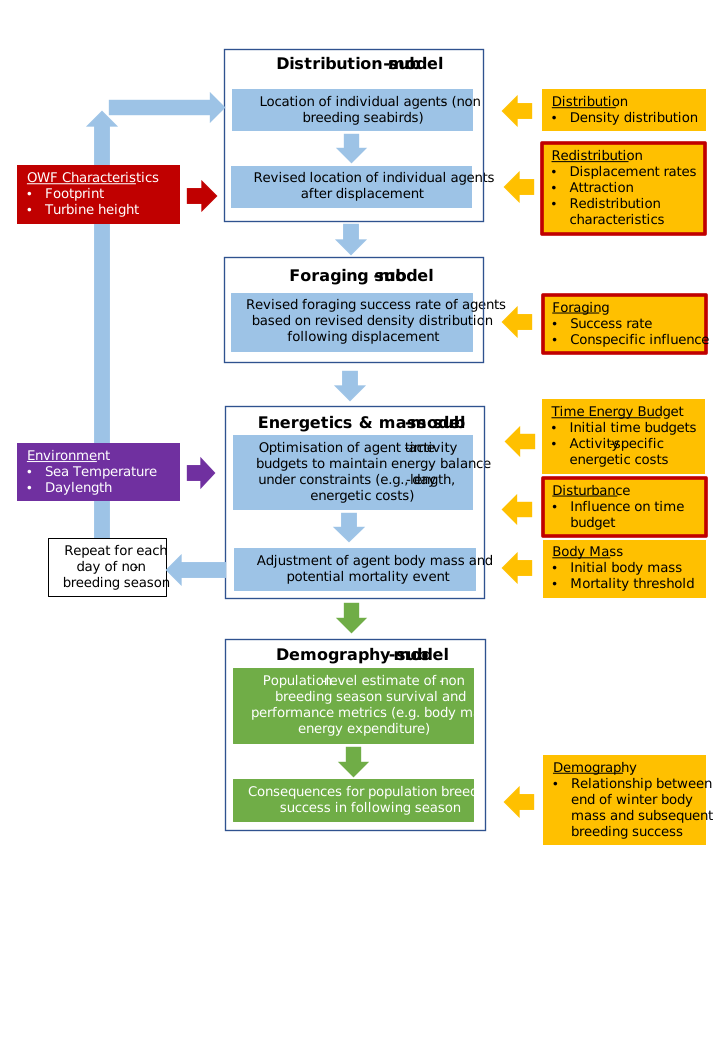
The DisNBS started with a design phase, underpinned by an expert consultation workshop. The resulting generic structure is presented in figure 1, which the roamR package implements. The demography submodel is not formally part of the IBM, but the energetics and body mass distributions that are generated will inform these down-stream calculations.The following document is a high-level description fo the functionality within the roamR package, that encompasses the design elements of figure 1.
Package overview
roamR is written in R using S4 classes (refer here for an overview and
later section) and has been structured/implemented such that the
simulations are well defined, but with a lot of flexibility in what the
components can do. S4 programming imposes a level of formality to the
programming that helps make the software more robust. Animal IBMs are
spatiotemporal and can be based on very disparate data sources - so
roamR is particular in its treatment of space (projections etc), time
and units generally (as found in the units package). The
package was written with seabirds as the motivating case, but generally
for animals (indeed one of the main classes is
<Species>), noting the agnostic term
agent applies.
In brief - roamR:
defines the general characteristics of a type of agent (a species definition)
defines the environment the agent interacts with, and how this functionally affects its movement or behaviour
defines how agents move, with consideration of the environment, behavioural state, or body condition
defines the behaviours animals may engage in and how these change
creates many agents with stochastic properties in line with their species definition
runs the agents through the simulated environment over time, for a defined temporal resolution
measures the agents throughout the simulation
gives tools to query the condition of agents that have been simulated
A principal limitation in IBMs is the level of information you have available to parameterize how the agents behave. roamR is intended to function well across the data support spectrum (i.e. from information poor to information rich). The test cases here cover a range of data support:
Relatively data rich: Guillemots at the Isle of May, which are well studied.
Relatively data poor: Red-Throated Divers in the North Sea, which are less understood.
At the more extreme information end, roamR has been developed to simulate agents at a very detailed level, for example a population with extensive GPS tagging information. The exemplar that guided this was the Hidden Markov Model of McClintock & Michelot (2018) and subsequent fitting to detailed Fulmar track data.
R and S4 programming
This package assumes at least some minor familiarity with R. Its use for simulating birds in the context of OWF is illustrated using markdown in the associated example scenarios - avoiding the need for detailed R programming knowledge. These examples give the steps required which can be modified and followed for new cases. However, even within this use-case it is unavoidable that user-defined functions will be required: for example the energetics equations for a particular species’ activity states. There are a lot of features of the package that extend it well beyond these OWF seabird examples, but will require a deeper understanding of R in order to fully use these. In particular some familiarity with S4 is useful if you want to use the package beyond the narrow path for the bird IBMs that motivated the package. Regardless, there is some basic S4 information that is useful to bear in mind:
There are well-defined classes for many components of the simulation - the R objects will often contain slots that you access by name with the
@operator, as opposed to the$that is common for simple R objects.Classes are prescriptive in what they can contain, this means things are more robust but deviations will be rejected e.g. if the data is required to be a
<stars>object, you cannot store something else thereThere are a lot of background checks for conformity (as above), so what you do will be scrutinised at various levels and prevented if outside expectations. For example, spatial elements must carry coordinate references systems and projections, units must be specified for many inputs.
Dependencies
The package has been written with the intention of few dependencies on other packages. The dependencies that are needed have been chosen with stability and longevity in mind i.e. they are well maintained and programmed, where differing options are available. Notable examples are:
The sf (simple features) package, which is widely well regarded for spatial work and encompasses much functionality of other packages.
The stars package for dealing with spatiotemporal data structures, which is characteristic of much of the data required for animal movement IBMs.
Note: the units package is used heavily. Many parameters and data elements must have their units of measurement specified. This is one of several formalities the package imposes, to minimise careless errors and make the simulations well defined. The help files state where these requirements apply.
Package/class hierarchy
A great deal of thought has gone into the hierarchical structure, which means mainly the classes, how they relate to one another and therefore where data (including parameters) lies within these. This is summarised in the figure below:
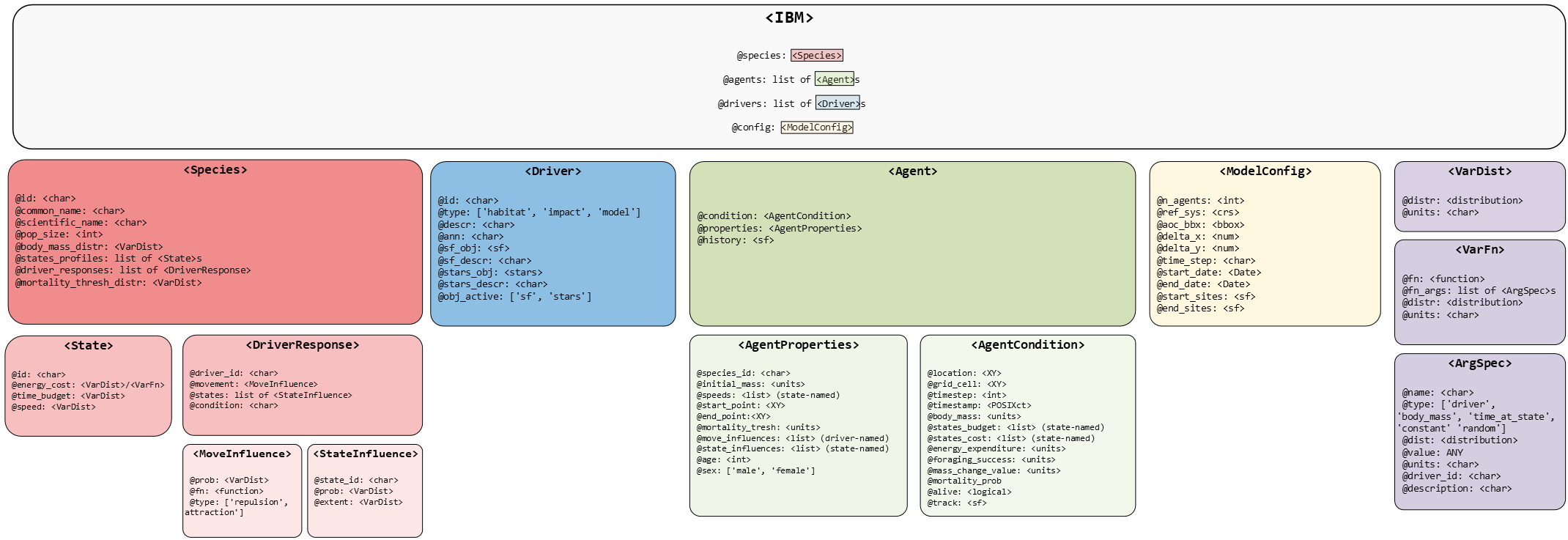
Key elements of this are discussed in turn, and examples are given in the associated test scenarios. Four main areas are covered:
The simulation engine and wrapper - offering high-level controls, like the number of agents, spatial/temporal boundaries (e.g. a bounding box, as distinct to environmental constraints of the simulation, fundamental spatial coordinate system
The species - properties of the population being simulated e.g. distributions of initial body mass, flying speeds. These are often distributional, as agents/individuals will be generate from these.
The environment - spatiotemporal descriptions of the agent’s environment within the simulation frame e.g. natural boundaries (coast), the Sea Surface Temperature (SST) over time, man-made structures (e.g. OWF)
The agents - the basic simulation element, largely defined from higher components, but the basis of monitoring the simulation and any counterfactuals
General workflow to create/run an IBM
The workflow to create/populate a roamR IBM is in essence:
Configure the simulation at a high-level, including the spatial and temporal boundaries, projections, number of agents etc.
Define the species, for example initial body mass distributions, flight speed distributions, activity states and their energetic implications, functional relationships between the species and the environment e.g. how SST affects energy, how OWFs influence movement/distribution.
Define the environment, essentially anything spatio-temporal that the animals are thought to respond to - coastline, man-made structures (e.g. OWF), prey distributions, SST, bathymetry etc.
Combine components into an IBM object.
Run a simulation, which creates agents, parallelises calculations, moves agents through the environment, and records their properties over time.
Alter simulation elements to reflect a perturbation (presence of OWF).
Re-run the simulation with the perturbation.
Query simulated animals, with counterfactuals based on within-agent comparisons over perturbation scenarios.
The key classes that require population in this workflow are expanded upon in turn.
The high level control (<ModelConfig> class)
This component provides the high-level configurations for the simulation, such as the spatial and temporal boundaries, the spatiotemporal resolution, the number of agents to simulate, the projection of the spatial data, and other general parameters that define the simulation environment. This also includes start and finish points for simulated animals, if some return-to-colony behaviour is required. Consideration in the setting of these follows.
Bounding Box (aoc_bbx) this is a
spatial extent over which the agents are constrained to be within. In
many cases this will simply dictated by the data, for example a density
distribution for the animal being simulated. If the animals have very
low probability of being beyond this data, then the bounding box
constraint is a logical progression. In other cases it might be set with
knowledge of the maximum range of the animal’s home range.
It is important to note that no movement outside this is permitted - so the box should be sufficiently large that it is not controversially influential i.e. err on the large side given other inputs will dictate travel. It also will bound spatiotemporal inputs, so data inputs are clipped to this region. A potential consequence of making the bounds very large is that large amounts of data be retained needlessly.
Spatial Resolution (delta_x,
delta_y) this defines the resolution of any spatiotemporal
datacubes that underpin the IBM. Note, this does not define the
resolution of the movements of the agent, just the resolution of data
describing its environment. This can simply be set to match the finest
scale of the input data, the only cost being the size of data being
carried forwards.
Temporal Bounds (start_date,
end_date) a nominal period the simulation applies to. Some
care is needed such that input data covers this period. For example, if
the simulation is envisaged to be running in the future, temporal inputs
should similarly be nominally for this period e.g. if using historic SST
data, this needs to be timestamped for the projected simulation
period.
Number of agents (n_agents) there is no
strong guidance on this, but is should be a considered choice. A general
rule of thumb is that more would be better (similar to any computer
intensive inference) so should be “large”. Note, the amount of
calculation, and hence time to run the simulation, is linear with
regards this. Similarly agents are tracked and stored in detail, so may
result in non-negligible storage sizes.
Ultimately the the outputs will be distributions of metrics from the agents, so sufficient are needed to characterise these distributions well/stably. A balance of computation time and accuracy of the distribution shape may be needed, if computation time is large - else just select a large number. The number of agents does not need to match the number of individuals in the population being simulated, they represent a sample of potential realities or animals as for any computer-intensive inference.
Defining the species (<Species> class)
This provides the general features that are realised in the agents, either stochastically (e.g. initial body mass) and/or functional relationships with the environment (e.g. how SST affects energy expenditure). It has been named species but could be considered a population depending on the context e.g. if there are parameters known down to a colony level, and potentially different from other colonies.
[Note the package also has a <varDist> class,
which gives a common interface in setting stochasticity, based on the distributional
package]
Labels (id, common_name,
scientific_name) these are used to identify the species in
the simulation, and can be used to query the simulation results. They
are not used in any functional way, but are useful for labelling outputs
and queries.
Body mass (body_mass_distr) this is a
distribution of the initial body mass of the agents, which can be
defined as a <VarDist> object. This is used to
initialise the agents with a body mass that reflects the population
being simulated. The distribution can be defined using any of the
supported distributions in <VarDist>, such as normal,
log-normal, or gamma distributions.
Mortality Threshold
(mortality_thresh_distr) defines thresholds where agents
are considered to have died, based on their body mass. Note, agents are
nominally tracked through the simulation even if marked as dead. This
allows other post-processing relationships to be explored, such as
defining fatality as a function of time spent below a %-age of starting
body mass.
Population Size (pop_size) this is a
nominal size of the population being simulated, which can be used to
optionally scale the results of the simulation.
Activity States (activity_states) this
is a list of ActivityState objects, which define the
different states that the agents can be in, such as foraging, resting,
or flying. Each state has a name, a distribution of body mass loss, and
a distribution of flight speed. The states can be defined with different
distributions for different species, and can be used to model the
behaviour of the agents in the simulation.
Response to Environment
(driver_responses) these are custom defined functions that
relate species (and therefore agent) behaviour with regards their
environment, as represented by the <Driver> class.
These are a very flexible element of the simulation, so expanded upon
below.
Driver responses
A key element of the IBM is the responsiveness of the agents to their environment, which includes standard biological factors such as prey distributions, bathymetry or coastlines. Treated generally, this also includes anthropogenic factors such as OWF, which are the focus of perturbation scenarios to be explored in the IBM. These are collectively termed drivers, as they drive agents behaviour, including movement, activity states and by extension their distribution and energetics.
The drivers are encompassed in <Driver> objects,
which might be themselves general and not species-specific. Here within
the <Species> class, the link between the environment
is made explicit and species-specific. These are very broad in what they
can encompass, being user-defined. For example:
Relationships between movement and proximity to coast. The coast movement driver in this case is distance to coast, calculated internally from coastline polygons. The correlated random walk movement model is fundamentally direction and speed, so a sharply declining driver response influences agents away from coastlines.
Relationships between movement and OWF. The coast movement driver in this case is internally calculated distance to development(s), and the driver function can call on properties of the development e.g. height of turbines, simulating line-of-sight influences or similar. Relatedly, this can simply be a barrier effect - the agent cannot pass through an OWF footprint/polygon (noting a specified proportion of agents can been set to be sensitive to OWF, also through the species definition).
States: activity budgets and rebalancing
The possible activity states of agents are defined within the species definition as above. A design element of the IBM is that the daily activity budget (time spent in each state) is not fixed, and can be responsive to environment and agent condition. roamR allows a “state rebalancing” on a daily basis, with the rationale that agents will attempt to compensate for poor foraging say, by increasing the amount of time dedicated to feeding.
roamR allows for this state distribution to be dependent the previous day’s net energy intake. To achieve this, a target daily net energy is specified e.g. for a species that is thought to have similar weights at beginning and end of the season, this target is zero. A day with poor energy intake will attempt to be compensated for, by a subsequent increase in time spend feeding. This adjustment is made such that:
The change in activity budget would on average balance out the previous days’ intake against the energy target. Note this will not be exact, as the daily energy intake achieved is subject to stochastic elements.
The changes in activity to seek energy balance are primarily through increasing/decreasing feeding and resting times.
Agents are constrained to rest overnight, which is based on day length calculations for the agent’s location and time.
All activities outside explicit feeding and resting are scaled accordingly, such that a full day’s activities are defined (i.e. a probability distribution for the day is maintained).
Defining the environment (<Driver> class)
Information about the simulated environment which might be
influential on agent’s behaviour is encapsulated in the
<Driver> class. Generally these are spatiotemporal
data cubes (a data structure here that is effectively a series of maps
stacked by time), such that the agents can query them for any time and
location. The actual information contained within the driver can be of
varying detail (e.g. low spatial resolution, fixed over time, or highly
detailed spatial information that varies with time) but the interface to
this is consistent: the agent queries all relevant drivers at location
,
at time
.
Vector fields
Generally animals are not simply responsive to their immediate environment, for example favoured feeding grounds that are not immediately within their sensory range. roamR includes the calculation of vector fields, which give direction and slope for any point on a provided surface. In conjunction with the driver response functions, this allows the IBM to direct movement through the environment towards distant favoured regions, or conversely away. Distance and direction to nearest OWF development, or coastline being particular examples.
The basic unit (<Agent> class)
The agents within the simulation are treated as self-contained
entities, that are moved and measured through the environment subject to
their individual properties. The specified number of agents are created
at the start of the simulation, with their properties defined by the
<Species> class. Initialisation of the agents is done
by sampling from the distributions defined in the
<Species> class, such as initial body mass, flight
speed, and activity state.
Agent properties
At initialisation, the following (non-exhaustive) properties are generated for each agent. These are fixed throughout the simulation, being fundamental to the agent for a simulated season:
initial_mass <units> object, the
agent’s body mass at the start of the simulation.
speeds a named list, defining movement speed
properties for the agent. Each element specifies the agent’s average
speed for a given movement state (e.g. flying, swimming, etc). List
elements must be of type <units>.
start_point, end_point objects of
spatial class <XY>, the spatial coordinates of the
agent at the start and end of the simulation, respectively.
mortality_thresh <units> object,
the threshold body mass below which the agent is assumed to die.
move_influences a named list, defining whether the agent is influenced by model drivers. Each element corresponds to a driver_id (which must be defined in the model’s Driver object) and contains a single-row data.frame with columns:
p: numeric, providing the probability that the agent is influenced by the named driver.
infl: logical, whether the agent is influenced by the driver. It should be determined via a Bernoulli trial with probability p.
state_influences a named list, defining whether agent states are influenced by model drivers. Each element, named after a driver_id, contains a data.frame with columns:
state_id: character string, the unique identifier of an agent’s state.
p: numeric, the probability that the agent’s state_id is influenced by the driver.
infl: logical, whether the agent’s state_id is influenced by the driver. It should be determined via a Bernoulli trial with probability p.
Agent condition
The agent’s condition is a dynamic aspect of the simulation, which is updated at each time-step. It includes the agent’s current location, body mass, activity states, and other properties that change over time. The condition is updated based on the agent’s movement, activity states, and interactions with the environment:
location object of class <XY>,
specifying the agent’s spatial coordinates at the end of the current
time-step.
grid_cell object of class <XY>,
representing the AOC’s grid-cell occupied by the agent.
timestep integer, indicating the current simulation time-step index.
timestamp a <POSIXct> object, the
date-time at the end of the current time-step.
body_mass a <units> object,
defining the agent’s body mass at the end of the current time-step.
states_budget a named list, detailing the agent’s
time allocation across the different behavioural/activity states during
the time-step. Each element (of type <units>) is
named after a specific state and stores the duration (e.g. hours) the
agent spent in that state.
states_cost a named list, specifying the energy
costs (e.g. KJ/hr/g) associated with each state defined in state_budget.
List elements are of type <units>.
mortality_prob numeric, the probability of the agent dying within the the current time-step (currently ignored).
alive a logical value (TRUE if alive, FALSE if dead), indicating whether the agent has survived the time-step.
track object of class <sf>,
storing a time-series of location points tracking the agent’s movement
within the current time-step.
energy_expenditure a units object,
representing the total energy (e.g. KJ/g) expended across all states
during the time-step.
foraging_success a units object, the
mass of prey (e.g. grams) consumed by the agent in the current
time-step.
mass_change_value a units object,
capturing the net change in the agent’s body mass (e.g., grams) over the
current time-step.
Agent history
The agent’s condition is generally dynamic throughout the simulation and can be sufficient to answer questions motivating the IBM e.g. body mass at the end of season. More generally however, a full record may be sought so the agent class contains a history component which stores the agent’s condition in a spatiotemporal data structure. This allows examination of movement, time spent in behaviour states, physical condition etc at any point in time.
Moving agents, running the simulation (<IBM>
class)
Fundamental to the IBM is the movement of agents. Currently roamR supports two movement models, which have different data/input requirements: one relatively simple requiring only basic knowledge of an animals speed of movement, the other a more demanding correlated random walk that would require detailed tracking data and parameter estimation from a Hidden Markov Model (HMM). The choice between these will be clear - if there is not support for a fine-scale movement model, then the simpler model will necessarily be chosen as the turning angle, step length and correlations are not able to be populated.
Movement models
Two agent movement methods are supported, presented here in order of complexity/data requirements.
Density-informed this method uses density information to generate stochastic destinations for the agents, which are combined with activity budgets and basic speed information to give travel paths. The process is:
Use the species’ density information in a likelihood fashion to generate a target destination for an agent i.e. high density areas are relatively more likely to be chosen.
Determine a feasible path from the current location to the destination - feasible here meaning that the path does not cross any barriers that apply from the driver response functions (e.g. OWF, coastlines) and is within the bounding box of the simulation.
The agents travel along the path is constrained/dictated by the agent’s speed properties and activity budget over time, for example an hour of flying within a day coupled with an average speed is used to calculate expected travel distances, under assumed random walk properties.
Iteratively regenerate destinations and paths
Correlated Random Walk (CRW) this method is commonplace in movement simulation literature, and consists of iteratively generating stochastic movement directions, then making a stochastic step. The distributions can impose dependencies to provide a directed random walk, and when related to local drivers, be functionally responsive to the environment. The process is primarily:
Select a stochastic movement direction based on a circular distribution (wrapped Normal in roamR). The mean (direction) of the distribution may be functionally related to local conditions e.g. vector field giving distance and direction to OWF. The variance of this distribution imposes the correlation (low variance is very directed movements).
Select a stochastic step length based on a distribution (e.g. gamma).
Iterate.
The properties of this movement can be made state dependent e.g. flying (fast and directed), resting (stationary) - depending on the species definition.
The second of these movement models is data intensive, requiring detailed tracking information to parameterise.
Agent evaluations
At each movement step the agents are evaluated, which includes simple location, but storing or calculating multiple properties:
The location and time
Activity state(s)
The cumulative net energy - based on user definitions, but generally a function of environment and activity state e.g. the amount of time in a feeding state, stochastic energy loss combined with local SST and balanced against energy intake.
Direction of travel, speed, depending on movement model.
Agent body mass, depending on population of energy-to-mass conversion functions
Additionally, state transitions for the next step may be calculated - as described in the state balancing section previously, where activity states are related to energy intakes at time .
Outputs
A principal use of the IBM is to run counterfactuals, where the simulation is run with and without a perturbation, such as the presence of an OWF. There are run in roamR in a paired fashion: the same agents are used in both scenarios, with changes only imposed on the definitions of the environment. Maintaining the same random seed sequence in both cases means the paired agents will start with the same properties, and subject to the same stochastic influences except where the perturbation creates changes.
Quantification of the impact of the perturbation can be done on any of the defined agent condition (and/or history), but likely to be differences in:
Cumulative net energy
Season-end body mass or mass change
Distributions of activity/behavioural states
Minimum body mass over the season
Mortality
As a mass-agent IBM, these are not single values, but distributions representing the variability in the simulated populations e.g. the distribution of differences in end-of-season body mass from baseline compared to OWF perturbation. These directly informative at a population level, and tangible for down-stream calculations. For example, passed to Population Viability Analyses (PVAs) where counterfactuals may use:
Increases in mortality/proportional reductions in population size
Relationships between body mass and reproductive success, to alter PVA demographic parameters
References
McClintock BT, Michelot T (2018). “momentuHMM: R package for generalized hidden Markov models of animal movement.” Methods in Ecology and Evolution, 9(6), 1518-1530. doi:10.1111/2041-210X.12995, http://dx.doi.org/10.1111/2041-210X.12995.